I upload videos to YouTube every day.
Don’t worry about the view count; maintain your enthusiasm every day.
Also, remind users to like, comment, and follow in your videos.
Use a gimbal to film yourself, keeping your face centered at all times.
Find a topic or field that you’re passionate about and update your content daily.
My own opinion
Every day, when I don’t know what to do, I watch YouTube.
I watch what videos others have posted, what the videos are about, and why they posted them.
This allows me to learn how to analyze videos and how to create them, and I can also keep up with news, trending topics, and things I’m interested in.
I organize this information on my WordPress blog, writing down whatever comes to mind, ideally transforming it into my own data charts and graphs, like an online magazine, but not a tutorial.
Hardware costs
Setting up a price monitoring system
For example, using Orange Pi 3B and Raspberry Pi
For devices you already own, consider selling them when prices rise and buying them back when prices drop. This won’t affect PVE and system data; you can simply swap the SSD drives.
For Raspberry Pis you plan to buy, constantly monitor prices and buy them at the lowest price. Pay attention to both new and used devices.
Windows desktop
Deploy a background removal tool (an all-in-one package) onto the ZeroPC computer, utilizing it efficiently and avoiding waste.
Also, use it for OCR or other Windows GUI applications, or other image processing tasks that require performance.
Play games, record vlogs about your outfits, gaming, food, daily cleaning, etc., and post them on your social media channel.
Write Chrome extensions to run on the GUI computer.
Spoken video
In small rooms and on small YouTube channels,
you should be creating vlogs, casually filming yourself every day, simply talking about what happened that day, developing camera presence and a habit of sharing your daily life.
This is the foundation for gaining traffic and the secret to attracting viewers.
Digital human model
Today I spent several hours troubleshooting and trying again to use AIGCpanel’s digital human video lip-syncing feature.
I tested the Wav2Lip model, but it kept giving errors, or the lip movements didn’t change, and there was an extra mouth in the upper left corner.
I tested the LatentSync model, but because the project is so new, it couldn’t recognize my P106-100 graphics card, so I could only use the CPU, which was too slow and laggy, so I ruled it out.
I tested the MuseTalk model, which could recognize my graphics card, but it was still incredibly laggy, with the progress bar not moving at all, so I ruled it out.
I was about to give up.
Then I found a third-party Wav2Lip package, and I realized that the problem was with AIGCpanel’s model.
AIGCpanel doesn’t allow you to adjust parameters or change models, which leads to various strange problems.
Using the Wav2Lip package, I found that I could adjust the key parameters myself, and there were no errors, no extra mouth in the upper left corner, or strange issues like masks on the mouth.
Then I tested the HeyGem package provided by the author of the Wav2Lip package, but I found that it didn’t work as well as Wav2Lip.
So, after spending a whole day, I concluded that my graphics card is only suitable for Wav2Lip, and I was severely let down by AIGCpanel’s Wav2Lip implementation.
Ultimately, testing a 2-minute 1080p video, Wav2Lip takes about 30 minutes to render the lip-syncing. Currently, there are no obvious inconsistencies; it’s not perfect, but at least it’s watchable, with about 70% lip-sync accuracy. For a talking head video, and considering my $30 graphics card, it’s quite good.
It’s important to note that Wav2Lip requires a face in every frame, so I recorded the talking head video using a DJI gimbal. Currently, there are no major problems.
BTCPay Server progress
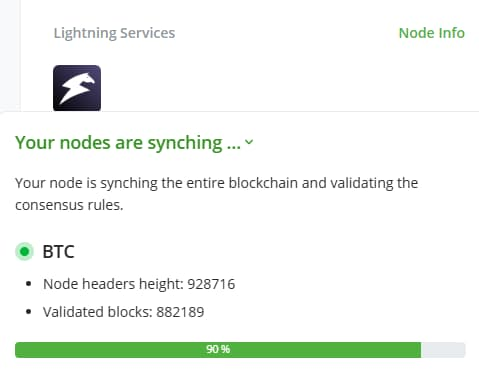
Today is the fourth day of deploying BTCPay Server, and the progress is only at 90%.
I don’t know when the node synchronization will reach 100%.
Tips
As of today, I have finally completed the qualitative analysis for my long-form videos, which are primarily based on spoken narration.
For other vlogs, tutorials, or documentaries, once the spoken narration is recorded, everything else is just a hobby, entirely dependent on my mood and luck.
Tomorrow, I plan to optimize the large-scale model for voice transfer.